Privileges determine what actions each employee can perform in the app. Create privilege groups based on job roles (e.g., floor staff, manager, or cashier) and assign them to the corresponding employees.
We recommend applying the principle of least privilege: activate only the permissions strictly necessary for each role. Permissions related to cash closes, payments, voids, and unlocks should be reserved for managers.
1. OVERVIEW
1. Access the Revo XEF back-office.
2. Go to Configuration / App privileges.
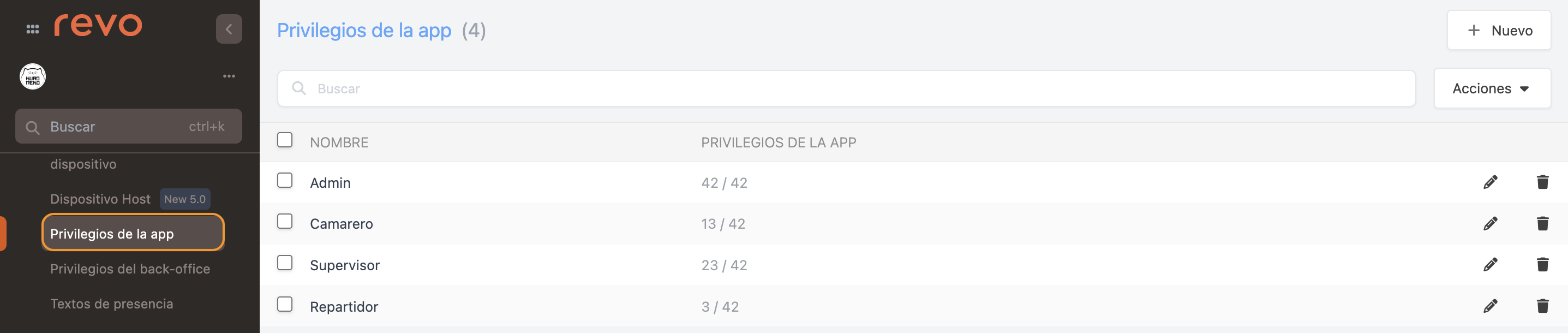
| ELEMENT | DESCRIPTION |
|---|---|
| + New | Creates a new privilege group. |
| Search | Filters and searches among existing privileges. |
| Actions | Deletes one or more selected privileges. |
| Name | Identifying name of the privilege. |
| App privileges | Indicates how many active permissions that group contains (e.g., 13 out of 43). |
| Edit / Delete | Icons to modify or delete the privilege group. |
2. HOW TO CREATE A NEW PRIVILEGE
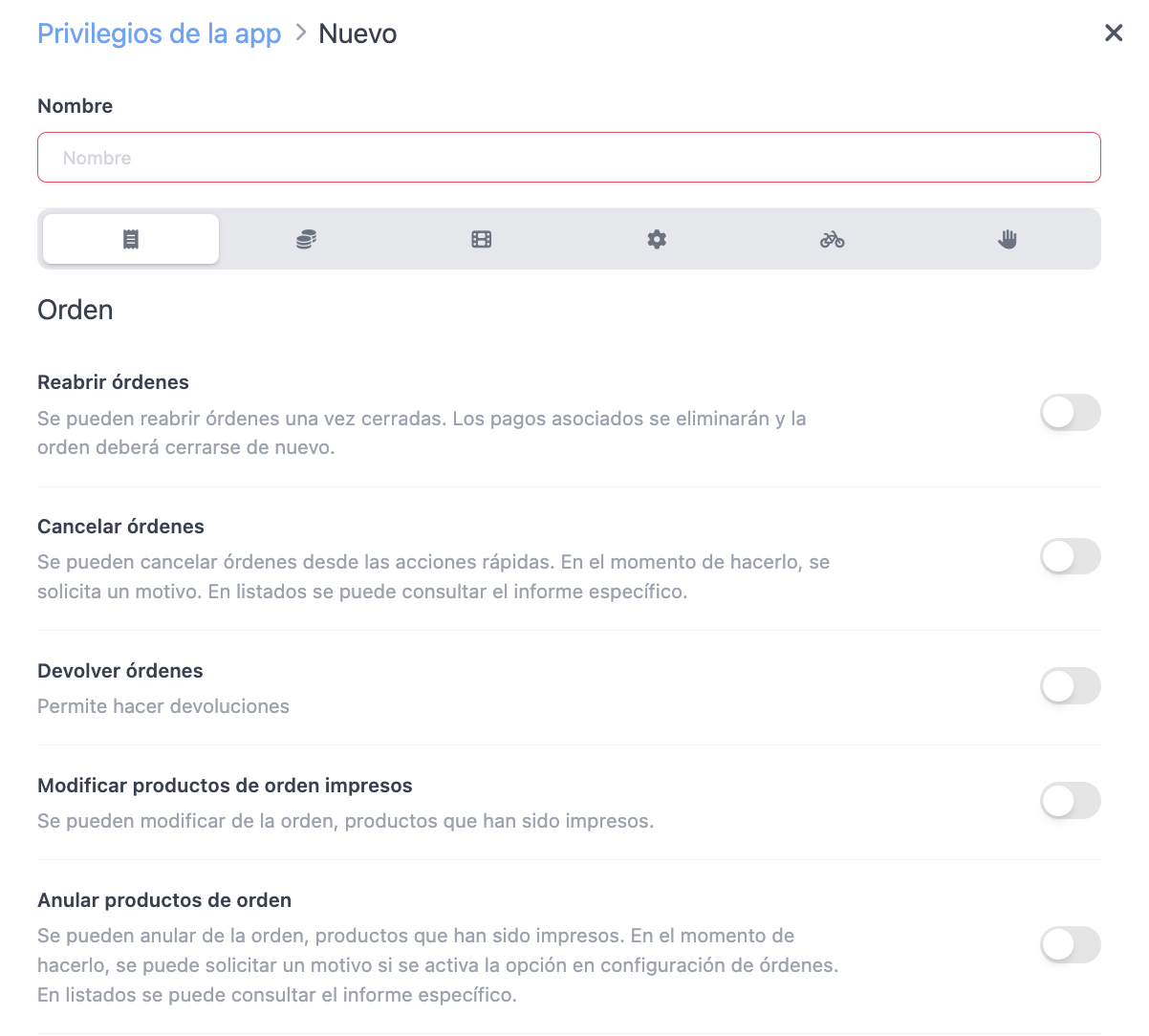
1. Click the + New button and assign a Name that allows you to easily identify the role (e.g.: "Terrace Waiters" or "Managers").
| FIELD | DESCRIPTION |
|---|---|
| Name | Add a descriptive name to identify the privilege group. |
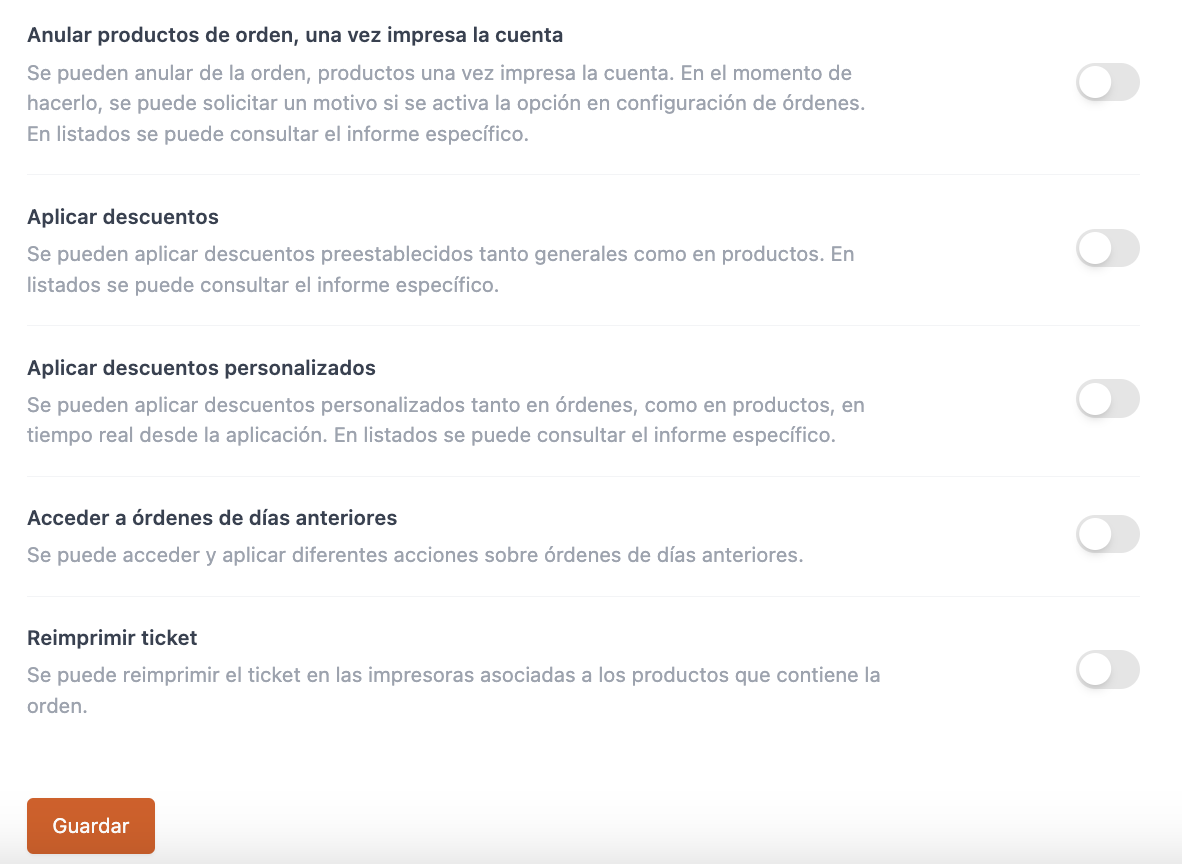
2. Next, activate the detailed permissions in the different configuration blocks and click Save.
3. LIST OF PERMISSIONS
ORDER
| PERMISSION | DESCRIPTION |
|---|---|
| Reopen orders | Authorizes the reopening of an already closed order for correction. When reopening a closed order, the associated payments are reversed via automatic refunds. The order remains open to apply changes and must be closed again. Useful for fixing billing errors. |
| Cancel orders | Enables order cancellation from the quick actions. The system requests a reason to keep a record of the incident, which can be reviewed later in the reports. |
| Refund orders | Grants access to perform order refunds. Use it when it is necessary to reverse an already completed sale according to the establishment's procedure. |
| Modify products sent to preparation | Authorizes the modification of order products that have already been sent to preparation or printed. It is useful for correcting an observation, a quantity, or an option requested by the customer after sending the ticket. |
| Delete products sent to preparation | Enables the removal of products already sent to the kitchen and/or KDS. Without this option, the employee will not be able to remove those lines from the order and must follow the established cancellation process for the entire order. |
| Void products with printed bill | Authorizes the cancellation of products from an order after printing the bill. If the order configuration requires it, the app will request a reason. Voids are available for consultation in the reports. |
| Apply discounts | Grants the use of pre-established discounts, both general and on specific products. Assign this permission when the employee must apply previously configured promotions or discounts. |
| Apply custom discounts | Enables the creation and application of manual discounts, general or on specific products, while taking the order. These discounts are one-off and are not saved as reusable options. To have a permanent discount, configure it beforehand in the back-office. Attention: Since it directly affects the final price, reserve it for managers. |
| Access previous days' orders | Grants access to open previous days' orders and perform authorized actions on them. It should be assigned only to profiles that need to manage incidents or reviews after the daily close. |
| Reprint receipt | Enables reprinting the receipt on the printers associated with the order's products. It is useful when a print job was not received correctly or a new copy is needed for preparation. |
| Mark as printed | Authorizes manually marking contents as already printed in the kitchen. Use it when preparation has been managed outside the usual printing flow and you need to update the content status in the order. |
CASH CONTROL
| PERMISSION | DESCRIPTION |
|---|---|
| Charge orders | Grants access to the charge action to finalize an order using the available payment methods. Without this, the employee can take orders, but not complete them by charging. |
| Canceled payments | Authorizes the use of the "Canceled" payment method. Use it only when the internal procedure requires registering the payment with this status. |
| Void payments | Enables the voiding of payments from the order history. The action requests a reason, is recorded in the order activity, and can be reviewed from the reports. Attention: It must be reserved for responsible profiles because it affects already registered payment operations. |
| Access Reports | Grants access to view and print the Z Report and the daily summary from the app. Assign this option to employees who need to check closes and summarized operational information. |
| Access inventory | Authorizes the employee to access the Stock app. Note that it does not replace the specific permissions configured within the inventory functions. |
| Cash in/out | Enables the registration of cash entries and exits from the cash control. It is useful to document exits to pay a supplier or entries to add change to the drawer, always according to the establishment's procedure. |
| Cash control | Grants access to the cash control to open and close shifts, check the cash count, and print the Z Report and other available reports. It is a suitable permission for shift or cash managers. |
| Print general Z Report | Authorizes the printing of the Z Report for all configured cash drawers in the account. It is different from the usual access to reports for a specific drawer or shift; it must be assigned to profiles with global cash responsibility. |
| Change payment method | Allows modifying the payment method of an invoice when it needs to be corrected. The level of control is defined by the administrator as Never, Always, or Only in current shift. |
| Proforma invoices | Enables the printing of proforma invoices. Use it to give the customer a document prior to payment or a detailed bill before finalizing the sale. |
ORDER ACTIONS
| PERMISSION | DESCRIPTION |
|---|---|
| Rename table | Authorizes changing the displayed name of a table from the order. It can be used to temporarily identify a table, a zone, or a customer when operations require it. |
| Scan QR code | Enables scanning products from a QR code. This action exclusively activates the product code scanning for the Balance Codes integration. It is not intended to freely add any product to an order without that integration. |
CONFIGURATION
| PERMISSION | DESCRIPTION |
|---|---|
| Device preferences | Grants access to device preferences from the app. The changes available in the configuration section may be limited by the complementary Sections permission. |
| Sections | Defines which sections of the device preferences the employee can modify. Use it to grant access only to necessary areas and prevent unwanted changes to the technical configuration. |
| Change preferences profile | Authorizes changing the device's preferences profile from the app menu. It is useful when the same device must use different configurations depending on the service, zone, or working mode. |
| Log out | Grants the option to log out of the account in the app. Assign this access when the employee must be able to end the device session or change users via the usual flow. |
| Access Integrations | Enables opening the integrations section from the app menu. The available options will depend exclusively on the integrations configured for the account. |
| Switch account | Authorizes switching between XEF accounts without logging out. It is useful for authorized employees who work with more than one operational account. |
| Edit tables | Grants table plan editing from the app. It must be assigned only to profiles that manage the floor layout, as changes can affect overall daily operations. |
| Assign identifier to employee | Authorizes linking a new identifier to the employee. Limit this action to managers, as identifiers are used to securely recognize users within operations. |
| Create customers | Enables the creation of new customers from the app during operations. It is useful when you need to record a customer's billing details without accessing the back-office. |
| Deactivate products | Authorizes the temporary or permanent disabling of products in XEF or SOLO from the quick order actions. Use it, for example, when a product runs out or should not be available. |
| Activate products | Grants the reactivation of products in XEF or SOLO from the quick order actions. It is useful for restoring the availability of a product that had been deactivated. |
| Edit selling price | Enables modifying the selling price of products from the app. Attention: It must be assigned with caution and only to trusted profiles, as it directly affects the final order amount and revenue. |
| Create optional modifiers | Authorizes the creation of optional modifiers from the app. It is used when it is necessary to add an additional option or note to a product while taking the order. |
DELIVERY
| PERMISSION | DESCRIPTION |
|---|---|
| Delivery | Grants access to use the Delivery module. Assign this option to employees who manage home deliveries or the actions available within that environment. |
| Driver | Enables the employee to use the driver role in the Delivery module. It must be activated for profiles that directly perform or manage deliveries. |
OTHER
| PERMISSION | DESCRIPTION |
|---|---|
| Edit unshared tables | Authorizes the editing of tables opened by other employees. It is vital for managers who need to intervene in an order even if they did not open it initially. |
| Open cash drawer | Enables the cash drawer to open when printing a receipt. It must be assigned only to profiles that need to manage and process cash during service. |
| Force unlock | Grants the unlocking of an order occupied by another user. It is intended for exceptional incidents, such as a device without battery, frozen, or out of service. Attention: Its misuse can cause operational conflicts or loss of products and orders, so it is recommended to strictly limit it to administrators. |
| Cash machine | Grants access to the cash machine configuration. It must be assigned to employees responsible for operating or overseeing that integration on the device. |
| Empty cash machine | Authorizes performing empty cash machine actions. Attention: Due to its high impact on managed cash, it must be exclusively reserved for authorized and highly trusted profiles. |
4. BEST PRACTICES
We recommend periodically reviewing your privilege group configurations to ensure that no employee retains access to sensitive functionalities (such as editing prices, voiding payments, emptying cash machines, or forcing unlocks) if their role does not require it.